F
.
INTRODUCTION.
21
century. This is also proved by two other circumstances. Firstly
the narrative of the Vikramânkacharita ends with a war against
the Cholas and knows nothing of the great expedition into
Central India beyond the Narmadâ which Vikrama undertook in
1088. Secondly we learn from a remarkable passage of the
Rajatarangini, which confirms and amplifies Billana's state-
ments regarding himself, that the poet lived to see Harsha,
Kalas'a's son on the throne. This passage Raj. VII. 936-938,
which on account of a misprint for it in the Calcutta
edition and of Mr. Troyer's utterly mistaken rendering, has not
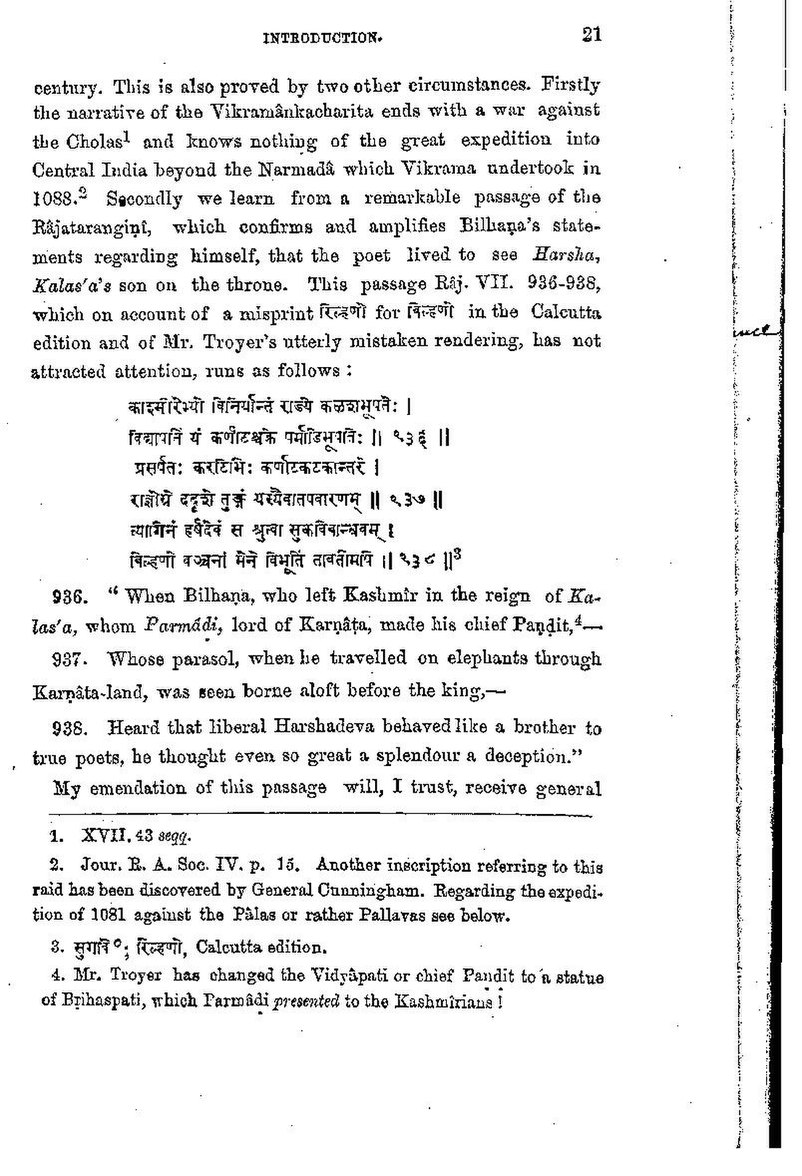
attracted attention, runs as follows:
काश्मीरेभ्यो विनिर्यान्तं राज्ये कळशभूपतैः |
विद्यापति यं कणीटश्चक्रे पडिभूतिः || ९३६ ||
प्रसर्वत: करटिभिः कर्णाटकटकान्तरे |
राशो दशे तुङ्गं यस्यैवातपवारणम् ॥ ९३७ ॥
व्यागिनं हर्षदेवं स श्रुत्वा सुकविबान्धवम् |
बिहणो वञ्चनां मैने विभूति तावतमा || १३८ ॥ १
936. "When Bilhana, who left Kashmir in the reign of Ka-
las'a, whom Parmádi, lord of Karnâta, made his chief Pandit,
937. Whose parasol, when he travelled on elephants through
Karnata-land, was seen borne aloft before the king,-
938. Heard that liberal Harshadeva behaved like a brother to
true poets, he thought even so great a splendour a deception."
My emendation of this passage will, I trust, receive general
1. XVII, 43 segg.
2. Jour. R. A. Soc. IV. p. 15. Another inscription referring to this
raid has been discovered by General Cunningham. Regarding the expedi.
tion of 1081 against the Palas or rather Pallavas see below.
3. सुगावे ; रिव्हणी, Calcutta edition.
4. Mr. Troyer has changed the Vidyâpati or chief Pandit to a statue
of Brihaspati, which Farmâdi presented to the Kashmîrians!
पृष्ठम्:विक्रमाङ्कदेवचरितम् - बिल्हण.pdf/२५
एतत् पृष्ठम् अपरिष्कृतम् अस्ति